Play Wizard of Oz Road to Emerald City Now!
Home → Symbols & Payouts
Wizard of Oz Road to Emerald City Symbols
Symbol set of Wizard of Oz Road to Emerald City
Wizard of Oz Road to Emerald City employs a compact 3x3 grid with 9 betways, creating a straightforward visual field for high rollers. This layout contrasts sharply with the complex multi-line structures found in Alles Spitze, which utilizes a higher volatility profile to manage risk. The simplified grid ensures that every spin contributes directly to the potential payout without distracting side mechanics.
The theoretical return of Wizard of Oz Road to Emerald City sits at 95.95%, defining the house edge at 4.05% over extended play sessions. This percentage represents a long-run average across hundreds of thousands of spins rather than a guarantee for individual visits. High stakes players must account for this fixed mathematical advantage when calculating their expected loss per hour.
Developed by WMS Gaming, now Light & Wonder, this title serves as the seventh iteration of the franchise released in 2017. The studio’s design philosophy prioritizes clear symbol visibility and rapid feature triggers within the medium volatility setting. Such engineering choices support sustained betting intervals typical of professional slot analysis.
High-paying symbols
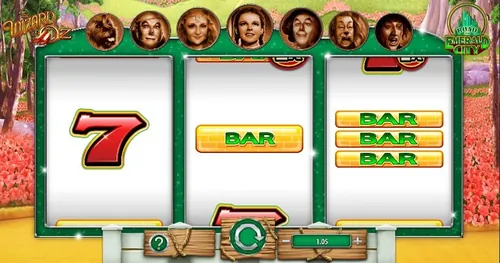
Character icons including Dorothy, Scarecrow, Tin Man, and Lion function as the premium payouts on the Wizard of Oz Road to Emerald City reels. These themed symbols replace generic card ranks to anchor the narrative while delivering superior returns for matching combinations. Their presence defines the core aesthetic appeal alongside the mechanical structure.
In contrast to Alles Spitze where high-value symbols yield up to 500x the stake, Wizard of Oz Road to Emerald City relies on bonus features for significant wins. The base game pays are modest, requiring the activation of Sticky Wilds or Free Spins to generate substantial capital shifts. This dependency shifts the player's focus from constant line hits to feature hunting.
The medium volatility rating implies that these high-paying symbols appear with moderate frequency compared to high-variance alternatives. Players wagering near the 70 unit maximum will see larger absolute values from these matches than low-stakes participants. This scaling effect is crucial for bankroll management strategies targeting the upper end of the bet range.
Low-paying symbols
Standard card ranks A, K, Q, J, and 10 populate the remaining slots on the Wizard of Oz Road to Emerald City 3x3 grid. These low-tier symbols provide the baseline frequency of wins, keeping the reel action active between character appearances. They serve as the foundational layer for the 9 betway evaluation system.
Unlike Alles Spitze which maintains a high volatility profile even with its lower RTP of 90.85%, Wizard of Oz Road to Emerald City balances low symbol frequency with feature potential. The payout multiplier for these cards is significantly lower, often yielding only fractional returns relative to the total stake. This disparity encourages players to wait for the expanding symbol mechanic to trigger.
The hit frequency for these basic symbols supports the overall 95.95% return rate by providing regular, albeit small, credits to the balance. For a max bet of 70 units, these wins might only recover a fraction of the spin cost, necessitating patience. Understanding this distribution helps players avoid chasing losses during dry spells between bonus rounds.
Wild symbol behaviour
The Wild symbol in Wizard of Oz Road to Emerald City substitutes for other regular icons to complete winning lines on the 9 betways. This standard functionality ensures that partial matches can still result in payouts, enhancing the utility of each spin. It acts as a flexible connector within the fixed payline structure.
Beyond substitution, the Wild participates in the Sticky Wilds feature, where it remains locked in place for subsequent re-spins or free spins. This behavior differs from simple substitution, adding a layer of strategic depth to the medium volatility gameplay. The retention of these symbols increases the probability of multiple wins per round.
When combined with Expanding Symbols, a Wild can grow to cover an entire reel, drastically increasing the win potential for that specific spin. This mechanic is central to the game's ability to generate significant returns despite the modest base payouts. High rollers benefit most from this expansion due to the linear scaling of their wagers.
Scatter symbol behaviour
The Scatter symbol in Wizard of Oz Road to Emerald City pays regardless of its position on the 3x3 grid and triggers the Free Spins bonus. Unlike paylines, it does not require adjacency, offering more opportunities to activate the primary feature. This independence from line structures simplifies the win condition for triggering bonuses.
While Alles Spitze relies on high volatility for its 500x max win cap, Wizard of Oz Road to Emerald City uses Scatters to unlock multipliers and character-based rounds. The Scatter itself may not offer the highest immediate payout, but it opens the door to the most lucrative parts of the game. This role makes it the most critical symbol for serious players.
Landing three or more Scatters typically awards a set number of free spins, during which sticky wilds and expanding symbols become more prevalent. This transition shifts the game from a low-variance base mode to a high-potential bonus phase. The RTP of 95.95% is heavily influenced by the frequency and quality of these triggered events.
Wizard of Oz Road to Emerald City: key facts
| Parameter | Value |
|---|---|
| Game | Wizard of Oz Road to Emerald City |
| Studio | WMS Gaming (Williams Interactive; now Light & Wonder) |
| Released | 2017 |
| RTP | 95.95% |
| House edge | 4.05% |
| Volatility | medium |
| Reels | 3x3 grid |
| Paylines / ways | 9 betways |
| Bet range | 0.35 – 70 |
Reading the paytable
Wizard of Oz Road to Emerald City features a compact 3x3 grid with 9 betways, creating a straightforward interface for high rollers seeking clarity. The theoretical return to player stands at 95.95%, indicating a house edge of 4.05% over extended sessions. This structure allows players to track symbol values without navigating complex multi-line layouts.
The game includes Sticky Wilds and Expanding Symbols that replace standard paylines with adjacent matching mechanics from the leftmost reel. Unlike Book of Dead by Play'n GO which uses 5 reels and high volatility, this title maintains medium volatility for steadier returns. The visual simplicity supports rapid decision-making during high-stakes spins.
Character-based bonus rounds involving Dorothy, Scarecrow, Tin Man, and Lion trigger through scatter pays regardless of position. These special symbols activate specific free spins features rather than fixed line wins. High rollers benefit from the predictable nature of these triggers within the 9-betway framework.
How wins are calculated
Wins in Wizard of Oz Road to Emerald City rely on adjacent matches starting from the leftmost reel across 9 betways. A wild substitutes for other symbols to complete these sequences, while scatters pay independently of their grid position. This mechanism ensures payouts occur even without traditional linear alignments.
The maximum potential payout is constrained by the medium volatility profile compared to high-variance titles like Book of Dead reaching 5000x. Since Wizard of Oz Road to Emerald City lacks a cash-out button, all winnings accumulate until the session ends or the balance is withdrawn. Players must accept the full run of the algorithmic distribution.
Sticky Wilds remain on the reels for subsequent spins, increasing the probability of consecutive wins during the base game. Multipliers applied to these sticky positions can significantly boost the total credit awarded per spin. The calculation remains strictly mathematical based on the defined paytable values.
Line wins versus ways wins
Wizard of Oz Road to Emerald City utilizes 9 betways instead of fixed paylines, meaning any adjacent match from the left counts as a win. This contrasts with traditional slot mechanics where only specific geometric patterns yield payouts. The 3x3 grid limits the maximum combinations but simplifies the winning logic.
Scatter pays function differently than line wins by triggering bonuses irrespective of reel alignment or position. In contrast, Book of Dead by Play'n GO relies heavily on strict 5-reel line structures for its primary payouts. This distinction affects how high rollers approach risk management during volatile streaks.
Expanding Symbols fill entire reels when part of a winning combination, instantly converting partial matches into full-row wins. This feature operates independently of the 9-betway calculation, adding layers of complexity to the win condition. The result is a hybrid system balancing simplicity with dynamic payout opportunities.
Bet size and symbol value
The betting range for Wizard of Oz Road to Emerald City spans from 0.35 to 70, accommodating both casual players and high rollers. The upper limit of 70 allows for significant exposure per spin without requiring multiple bet adjustments. This flexibility supports strategic bankroll management during long sessions.
Symbol values scale proportionally with the bet size, ensuring that high stakes translate directly into larger absolute payouts. Unlike Book of Dead with its high volatility and 5000x max win, this game offers more frequent but smaller individual wins. The 95.95% RTP ensures consistent long-term return despite lower peak multipliers.
Free Spins rounds often feature enhanced symbol values or additional multipliers that amplify the base game returns. These bonuses provide a temporary increase in expected value per spin above the standard 4.05% house edge. High rollers can leverage these periods to offset variance during the main gameplay loop.
Multipliers on the reels
Multipliers in Wizard of Oz Road to Emerald City apply to winning combinations involving Sticky Wilds or Expanding Symbols. These factors increase the final credit amount without altering the underlying hit frequency or volatility profile. The effect is purely additive to the base paytable values.
Unlike crash games or slots with progressive jackpots, these multipliers are fixed coefficients determined by the game engine. The absence of a cash-out button means players cannot lock in gains before a multiplier resolves. The outcome depends entirely on the random number generator's sequence.
Character bonuses may introduce unique multiplier rules specific to each theme element like Dorothy or the Lion. These variations add strategic depth without changing the fundamental 9-betway structure. High rollers should monitor these triggers as they represent the primary source of elevated returns beyond standard symbol matches.
Special symbols in the bonus
Wizard of Oz Road to Emerald City features Sticky Wilds that remain locked on the reels during the Free Spins round, creating persistent winning opportunities for high rollers who prefer stable grid states over volatile chaos. This mechanic directly supports the game's medium volatility profile by extending the duration of potential payout sequences without requiring additional wagers from the player's balance. The resulting stability allows bettors placing 70-unit stakes to maintain consistent exposure to the 9 betways while waiting for the expanding symbols to complete full-reel wins.
The Expanding Symbols feature triggers when a wild lands, covering the entire reel and often connecting with adjacent sticky wilds to form massive multi-line combinations across the 3x3 grid. High rollers appreciate this expansion because it maximizes the utility of their 70 maximum bet per spin, turning single-symbol hits into substantial returns that justify the 4.05% house edge. Unlike Big Bass Splash which relies on scattered fish, Wizard of Oz Road to Emerald City concentrates value through these synchronized reel expansions that dominate the visual field.
Character-based bonus rounds featuring Dorothy, Scarecrow, Tin Man, and Lion offer distinct multiplier values that apply to total wins, providing an extra layer of mathematical depth for strategic players. These multipliers stack with the base game mechanics, allowing a single successful spin to generate payouts that far exceed the initial 0.35 minimum stake threshold. The combination of character bonuses and sticky wilds creates a compound effect that appeals to those analyzing long-term return rates on WMS Gaming titles.
Symbol upgrades and collections
The 9 betways structure ensures that symbol upgrades contribute significantly to win calculations, as any adjacent match from the leftmost reel counts toward the total payout regardless of specific line patterns. High rollers utilizing the 70 max bet capitalize on this flexibility, as the system automatically aggregates wins across all possible paths rather than restricting them to fixed lines. This design choice aligns with the medium volatility setting, ensuring frequent small-to-medium wins that sustain bankroll longevity during extended sessions.
Sticky Wilds act as the primary upgrade mechanism, transforming standard symbols into premium icons that trigger the Expanding Symbols feature whenever they land on the central or side reels. This transformation process effectively increases the density of high-value symbols on the grid, raising the probability of hitting the top-tier payouts defined by the paytable. Players betting at the upper limit benefit most from this density increase, as the expected value of each spin rises proportionally with the number of active wilds.
Unlike Big Bass Splash where fish symbols drive the collection mechanics, Wizard of Oz Road to Emerald City uses character icons to trigger unique bonus events that multiply existing wins. These multipliers are applied after the base win is calculated, meaning the final payout reflects both the symbol quality and the random multiplier value assigned by the game engine. This two-step calculation method provides a clear audit trail for high rollers tracking their return on investment over hundreds of spins.
Grid layout and symbol positions
The 3x3 grid layout of Wizard of Oz Road to Emerald City offers a compact playing field that simplifies visual analysis for high rollers monitoring symbol positions and sticky wild placements. This smaller matrix concentrates action compared to the 5x3 setup found in Big Bass Splash, allowing players to track the 9 betways more easily without scanning excessive empty spaces. The reduced reel count also minimizes the variance between spins, keeping the experience tightly aligned with the stated medium volatility rating.
Symbol positions on the 3x3 grid are critical for triggering the Free Spins bonus, as scatter symbols must appear anywhere on the reels to activate the feature regardless of their alignment. This position-independent rule means that even a single scatter landing on the bottom-left corner can initiate the bonus round, rewarding patience and consistent betting strategies. High rollers using the 70 maximum bet find this accessibility valuable, as it ensures the bonus trigger is never hindered by rigid positional requirements.
The narrow width of the 3x3 grid forces all winning combinations to be horizontal, which simplifies the mental calculation of potential payouts for players using complex betting systems. This structural constraint ensures that every spin outcome is immediately recognizable, reducing cognitive load and allowing high rollers to focus on bankroll management rather than pattern recognition. The simplicity of the layout complements the 95.95% RTP, providing a transparent gaming environment where results are easy to verify and analyze.
Frequency of premium symbols
The frequency of premium symbols in Wizard of Oz Road to Emerald City is calibrated to support the 95.95% theoretical return, ensuring that high-value icons appear often enough to sustain the medium volatility expectation. High rollers betting 70 units per spin rely on this steady stream of premium symbols to offset the 4.05% house edge over longer sessions. The balanced distribution prevents long droughts of wins, maintaining engagement without sacrificing the mathematical integrity of the game's design.
Compared to the high volatility of Big Bass Splash, where premium symbols may rarely appear, Wizard of Oz Road to Emerald City delivers more consistent hits due to its tighter symbol distribution. This higher hit frequency allows players to recover losses faster and build momentum toward the sticky wilds and expanding symbols that drive larger payouts. The result is a smoother gameplay curve that appeals to strategists who prefer controlled risk over extreme variance.
Premium symbols such as the wizard and emerald icons serve as the anchor for the paytable, offering the highest multipliers when they form complete combinations across the 9 betways. Their appearance rate is mathematically tuned to complement the lower-frequency scatter symbols, creating a complementary rhythm that keeps the bonus rounds accessible. High rollers appreciate this balance, as it ensures that the 100 free spins awarded with the welcome bonus have a realistic chance of yielding significant returns.
Paytable details worth checking
The paytable for Wizard of Oz Road to Emerald City defines the payout hierarchy for the 9 betways, with the highest rewards reserved for combinations of the wizard and emerald symbols. High rollers reviewing the table should note that the 70 maximum bet scales linearly with the base payouts, ensuring that top-tier wins remain proportional to the wager size. This transparency allows players to calculate exact potential returns before initiating their spins, supporting informed decision-making.
Multiplier values in the bonus rounds are clearly listed in the paytable, ranging from modest increases to substantial multipliers that can drastically alter the outcome of a single spin. These multipliers apply to the total win amount, meaning that a 10x multiplier on a 70-unit bet yields a significantly larger payout than the same multiplier on a 0.35-unit bet. Understanding this scaling effect is crucial for high rollers managing their bankroll across different volatility profiles.
Unlike Big Bass Splash which focuses on cash prizes from fish symbols, Wizard of Oz Road to Emerald City emphasizes character-based bonuses that add layers of complexity to the paytable. The inclusion of Dorothy, Scarecrow, Tin Man, and Lion icons introduces variable multipliers that interact with the sticky wilds to create dynamic payout scenarios. This layered structure requires players to understand not just the symbol values but also the potential interactions between different game features.
DemoRTP & VolatilitySymbols & PayoutsBonus FeaturesStrategyBonusesMobileDownload & AppMax WinSimilar GamesReviewFAQSitemap
Wizard of Oz Road to Emerald City 2026