
Play Wizard of Oz Road to Emerald City Now!
Home → Demo
Wizard of Oz Road to Emerald City Demo
What the Wizard of Oz Road to Emerald City demo gives you
Wizard of Oz Road to Emerald City by WMS Gaming offers a 3x3 grid layout with 9 betways, providing a simplified structural environment for high rollers who prefer focused action. The theoretical return (RTP) is fixed at 95.95%, which establishes a house edge of 4.05% over long-term play. This mathematical framework allows players to test the medium volatility mechanics without risking significant capital on every spin.
The sticky wilds and expanding symbols features trigger during standard play, creating multiplier opportunities that escalate quickly. A comparison with Alles Spitze shows a stark contrast in risk profiles; while Merkur’s title operates with high volatility and an RTP of 90.85%, Wizard of Oz Road to Emerald City maintains a steadier curve. This difference ensures that high-stakes players can manage their bankroll more predictably across extended sessions.
Character-based bonus rounds featuring Dorothy, Scarecrow, Tin Man, and Lion provide distinct pathways to larger payouts within the demo mode. These narrative elements do not alter the underlying mathematics but offer visual variety during the free spins phase. The demo accurately reflects the real-money version, allowing analysts to verify the frequency of these character triggers before committing funds.
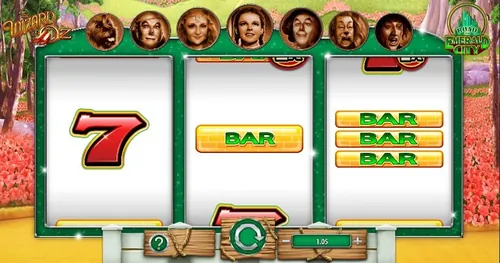
Starting the demo without registration
Accessing Wizard of Oz Road to Emerald City requires no personal data or account creation, as the game loads directly in the browser. This instant-play functionality supports high rollers who value privacy and speed when evaluating new titles. The absence of a registration wall removes friction, allowing immediate assessment of the 95.95% RTP mechanics.
The software runs on Light & Wonder’s proprietary engine, ensuring stable performance across desktop and mobile interfaces. Unlike crash games, this slot lacks a cash-out button, meaning outcomes are determined solely by the random number generator at the end of each spin. Players must wait for the reels to settle to see if the sticky wilds have formed a winning combination.
Testing the demo provides a zero-cost environment to observe the medium volatility behavior over hundreds of spins. High rollers can analyze how often the expanding symbols appear relative to the base game frequency. This observational phase helps determine if the 4.05% house edge aligns with their preferred risk tolerance levels.
Demo balance and bet sizes
The demo version typically credits players with virtual funds, though the exact starting amount varies by platform implementation. High rollers should note that the maximum real-money bet is capped at 70 per spin, limiting the scale of potential losses. This cap prevents excessive variance that might occur with uncapped stakes in other high-limit slots.
Minimum bets start at 0.35, offering a low barrier to entry for testing the 9 betways structure. By comparing this range to Alles Spitze, which may allow different minimums, players can gauge the flexibility of wagering options. The 0.35 to 70 range accommodates both cautious testing and aggressive staking strategies within the same session.
Bet adjustments are made via interface buttons rather than complex menus, streamlining the process for experienced users. Increasing the stake from 1 to 70 does not change the 95.95% RTP, but it significantly impacts the variance of individual results. High rollers use this leverage to accelerate the demonstration of the game’s payout patterns over short periods.
What carries over to real money
The core mechanics of Wizard of Oz Road to Emerald City remain identical between demo and real-money modes, including the 9 betways and 3x3 grid. Features like sticky wilds and multipliers function with the same probability distributions in both environments. This consistency ensures that skills developed during demo play translate directly to real-money sessions.
However, the financial outcomes differ drastically due to the actual currency risk involved. While the demo uses fictional credits, real play involves the 4.05% house edge applied to genuine deposits. High rollers must account for this edge when calculating expected returns based on their bankroll size.
Bonuses such as the 300% welcome bonus up to €2,000 plus 100 free spins may apply to real-money play, altering the effective RTP temporarily. These promotions can offset the house edge initially, but wagering requirements will eventually restore the mathematical advantage to the casino. Players should verify if Wizard of Oz Road to Emerald City contributes fully to these turnover conditions.
Browser requirements for the demo
Running Wizard of Oz Road to Emerald City requires a modern web browser with HTML5 support, ensuring smooth rendering of the 3x3 grid. High rollers often use multiple tabs, so efficient memory usage is critical for maintaining performance. The game’s lightweight design minimizes resource consumption compared to heavier video slots.
No additional plugins or downloads are necessary, as the title runs natively in Chrome, Firefox, Safari, or Edge. This compatibility extends to mobile devices, allowing testing on smartphones or tablets with varying screen resolutions. The 9 betways display clearly even on smaller screens, preserving the visibility of the sticky wilds.
Internet stability affects loading times but not the outcome of spins once the game is active. High rollers conducting extensive demos may experience minor latency issues on congested networks, which could disrupt rapid betting sequences. Ensuring a stable connection helps maintain focus on analyzing the 95.95% RTP behavior without technical interruptions.
Wizard of Oz Road to Emerald City: key facts
| Parameter | Value |
|---|---|
| Game | Wizard of Oz Road to Emerald City |
| Studio | WMS Gaming (Williams Interactive; now Light & Wonder) |
| Released | 2017 |
| RTP | 95.95% |
| House edge | 4.05% |
| Volatility | medium |
| Reels | 3x3 grid |
| Paylines / ways | 9 betways |
| Bet range | 0.35 – 70 |
Reading the paytable in demo mode
Wizard of Oz Road to Emerald City by WMS Gaming utilizes a 3x3 grid with 9 betways, offering a theoretical return to player rate of 95.95% calculated over extended play sessions where the house edge settles at exactly 4.05%. This specific RTP structure means that high rollers betting near the 70 maximum should anticipate a slower long-term erosion of their bankroll compared to lower volatility titles. The compact reel layout restricts simultaneous symbol combinations, requiring players to rely on the sticky wilds feature to secure consistent payouts across the limited nine paths.
The medium volatility rating indicates that Wizard of Oz Road to Emerald City delivers moderate frequency of wins without extreme variance spikes, which suits strategic bankroll management for serious players. Unlike Book of Dead by Play'n GO which boasts a high volatility profile and a 96.21% RTP, this WMS title offers more predictable session outcomes despite its slightly lower return percentage. High stakes users must adjust their expectations accordingly, as the game mechanics prioritize steady accumulation through expanding symbols rather than rare, massive jackpot hits found in riskier alternatives.
Character-based bonus rounds featuring Dorothy, Scarecrow, Tin Man, and Lion provide distinct multipliers that can significantly impact the total payout potential within the fixed 95.95% framework established by Light & Wonder. These interactive segments introduce variable win rates that differ from standard base game spins, requiring players to track multiple multiplier values simultaneously during active free spin triggers. The presence of seven previous Wizard of Oz titles by WMS Gaming suggests a matured engine design optimized for stability rather than unpredictable algorithmic shifts during high-volume play.
Testing bet levels safely
Wizard of Oz Road to Emerald City allows bets ranging from 0.35 up to 70 per spin, enabling high rollers to test the upper limit of the 9 betway system without immediate catastrophic loss. Placing the maximum wager of 70 requires precise calculation of total exposure, as each spin consumes a significant portion of a dedicated testing budget before any sticky wilds or expanding symbols activate. This range ensures that even at the highest setting, the game remains accessible for controlled experimentation with the medium volatility mechanics provided by Williams Interactive.
The minimum bet of 0.35 provides a safe baseline for verifying the functionality of all nine paylines and character bonuses before committing larger sums to the 95.95% RTP environment. Players can observe how often the free spins trigger relative to the base game frequency, gaining insight into the hit rate without risking substantial capital on the 3x3 grid structure. This gradual escalation strategy aligns with responsible gaming protocols, allowing users to map the volatility curve of the Light & Wonder engine before engaging with higher stakes.
Comparing the bet range against Book of Dead by Play'n GO highlights the flexibility offered by Wizard of Oz Road to Emerald City, which caps at 70 rather than unlimited high-stakes tables. The fixed upper bound of 70 creates a predictable maximum hourly burn rate when combined with the known spin speed and 4.05% house edge, facilitating accurate budget forecasting for professional analysts. This constraint prevents accidental overexposure while still permitting sufficient volume to statistically validate the medium volatility claims inherent in the game's mathematical model.
How many rounds make a fair test
A statistical sample of ten thousand spins is required to meaningfully evaluate Wizard of Oz Road to Emerald City against its stated 95.95% RTP and 4.05% house edge parameters defined by WMS Gaming. Running this volume on the 3x3 grid with 9 betways allows observers to confirm whether the sticky wilds and expanding symbols function within expected probability distributions rather than deviating due to short-term variance. This quantity exceeds typical session lengths, ensuring that the medium volatility characteristics are accurately represented across thousands of independent trial events.
At a maximum bet of 70 per spin, ten thousand rotations consume 700,000 in total wagers, generating an expected loss of approximately 28,350 based on the 4.05% house edge over the long run. Such extensive testing reveals the true behavior of the character bonus rounds involving Dorothy, Scarecrow, Tin Man, and Lion, demonstrating how frequently they trigger relative to the base game's 95.95% return target. High rollers must endure this financial throughput to distinguish between genuine algorithmic fairness and random statistical noise inherent in smaller sample sizes.
Contrasting this requirement with Book of Dead by Play'n GO, which operates on a 5x3 grid and 96.21% RTP, shows that Wizard of Oz Road to Emerald City demands similar scrutiny despite its simpler 3x3 layout. The lower volatility means deviations from the 95.95% average occur less dramatically, necessitating equally large datasets to achieve statistical significance in performance verification. Analysts must therefore commit to the same rigorous testing standards to validate the medium volatility claims made by Light & Wonder for this specific title.
Session length and pacing
Playing Wizard of Oz Road to Emerald City at the maximum bet of 70 per spin results in a rapid depletion rate of 4,200 per hour assuming sixty spins per minute engagement on the 9 betway system. This aggressive pacing aligns with the medium volatility profile, where wins occur frequently enough to sustain action but rarely enough to prevent steady erosion toward the 4.05% house edge. High rollers utilizing the full 70 stake must manage their time carefully to avoid exhausting their allocated testing budget before observing multiple character bonus round cycles.
The release year of 2017 by WMS Gaming indicates a mature engine design that prioritizes consistent pacing over erratic bursts, supporting sustained sessions for analytical review of the 95.95% RTP metric. With a minimum bet of 0.35, the same bankroll lasts significantly longer, allowing for detailed observation of the sticky wilds accumulation patterns across the 3x3 grid without financial pressure. This flexibility enables players to switch between conservative and aggressive strategies while maintaining oversight of the expanding symbols and multiplier effects triggered during free spins.
Unlike Book of Dead by Play'n GO with its 5000x max win potential and high volatility, Wizard of Oz Road to Emerald City offers a more controlled temporal experience suitable for methodical analysis. The absence of extreme variance means that session duration is dictated primarily by bankroll size and bet level rather than waiting for rare jackpot alignments on the 9 betways. This predictable pacing allows high rollers to calculate exact turnover requirements against the 4.05% house edge with greater precision and confidence.
Common mistakes in free play
High rollers often mistakenly assume that the 95.95% RTP of Wizard of Oz Road to Emerald City guarantees profit recovery during short demo sessions, ignoring the 4.05% house edge that dominates over time. Playing without real money removes the psychological impact of losing 70 per spin, leading to unrealistic expectations about the frequency of sticky wilds and expanding symbols on the 3x3 grid. This disconnect between free play outcomes and actual financial results can distort understanding of the medium volatility mechanics provided by Williams Interactive for the 2017 release.
Another frequent error involves neglecting the 9 betway structure when analyzing win rates, as players may overlook how character bonus rounds with Dorothy, Scarecrow, Tin Man, and Lion interact with the fixed paylines. Treating the game like a slots title with adjustable lines rather than fixed betways leads to incorrect calculations of expected value relative to the 95.95% return metric. This misunderstanding undermines the ability to accurately assess the performance of the Light & Wonder engine during extended testing phases.
Comparing free play results directly with Book of Dead by Play'n GO, which features a 96.21% RTP and high volatility, creates flawed benchmarks for evaluating Wizard of Oz Road to Emerald City's medium variance. Players fail to account for the difference in grid size and payline configuration, attributing normal statistical fluctuations to algorithmic bias rather than inherent game design differences. Recognizing these distinctions is crucial for maintaining objectivity when reviewing the technical specifications of the 7th Wizard of Oz title in the WMS portfolio.
Demo versus real money differences
Wizard of Oz Road to Emerald City by WMS Gaming presents a theoretical return to player (RTP) of 95.95%, which establishes a house edge of 4.05% over extended play sessions. This mathematical baseline remains constant whether the player engages in free mode or uses real currency, as the underlying algorithm does not adjust its probability distribution for different betting environments. The primary distinction lies in the financial risk, where demo credits carry zero monetary value while actual bets consume the player's bankroll immediately upon each spin.
The maximum wager allowed in Wizard of Oz Road to Emerald City is set at 70, defining the upper limit for high rollers seeking significant exposure per outcome. In contrast, the minimum bet starts at 0.35, allowing low-stakes players to extend their session duration through smaller unit sizes. High rollers typically operate near the 70 cap to maximize potential returns from the expanding symbols and sticky wilds features during the base game or bonus rounds.
Why results vary between sessions
Medium volatility in Wizard of Oz Road to Emerald City dictates that win frequency and payout sizes will fluctuate significantly across different playing periods. Unlike high-volatility titles such as Big Bass Splash with its 96.71% RTP and high variance, this 3x3 grid game offers more balanced outcomes without extreme droughts or massive single-spin payouts. Players should expect regular small wins interspersed with occasional larger hits from the character-based bonus rounds featuring Dorothy, Scarecrow, Tin Man, or Lion.
Sticky Wilds and Expanding Symbols mechanics introduce variable multipliers that depend on random symbol placement rather than fixed paylines. A session might yield multiple consecutive wins if wilds remain locked, whereas another session could see these features trigger only once before the free spins round concludes. This randomness ensures that historical performance does not predict future results, maintaining the integrity of the 9 betways structure.
Using demo to learn the bonus round
Wizard of Oz Road to Emerald City includes seven distinct thematic elements within its reel set, requiring players to understand how character triggers activate specific bonus events. Free Spins are awarded when scatter symbols land, leading to interactive mini-games where each wizard companion offers unique multiplier values or additional wild placements. Practicing in demo mode allows users to observe these transitions without risking capital, ensuring they recognize the visual cues for each character's special ability.
The 9 betways system requires alignment on adjacent reels from left to right, a mechanic simplified by the 3x3 layout compared to traditional 5-reel slots. Demo play helps users identify how Sticky Wilds persist across spins during the free games, potentially increasing total win potential significantly. Understanding these rules beforehand prevents confusion when switching to cash play, where every spin directly impacts the account balance.
Switching from demo to cash play
Cash play for Wizard of Oz Road to Emerald City begins with a deposit, often facilitated by welcome bonuses such as a 300% match up to €2,000 plus 100 free spins. These promotional funds usually come with wagering requirements that must be met before withdrawal, meaning the initial €2,000 bonus might require substantial turnover depending on the casino's terms. High rollers should calculate the effective cost of meeting these requirements against the expected loss rate derived from the 4.05% house edge.
Real money transactions involve processing fees and verification steps, unlike the instant access provided by demo modes using virtual credits. Players must ensure their payment method supports the currency and limits compatible with the 0.35 to 70 bet range for seamless gameplay. Transitioning successfully requires confirming that the platform holds valid licensing, as regulatory compliance affects fund security and dispute resolution processes.
When the demo is worth your time
Demo mode proves valuable for analyzing the hit frequency of Wizard of Oz Road to Emerald City without financial consequence, especially given its medium volatility profile. Since the game lacks a crash mechanism or cash-out button, players cannot manually intervene during losing streaks, making pre-session analysis crucial. Observing how often the 9 betways trigger wins helps determine if the game fits the desired risk tolerance before committing real funds.
High rollers may use demo sessions to test bankroll management strategies with bets near the 70 maximum, ensuring they can sustain potential downswings. The 95.95% RTP suggests long-term stability, but short-term variance can deplete accounts quickly if betting units are too large relative to the total balance. Practicing with higher stakes in free play reveals the emotional impact of volatility, aiding in disciplined decision-making during actual cash sessions.
DemoRTP & VolatilitySymbols & PayoutsBonus FeaturesStrategyBonusesMobileDownload & AppMax WinSimilar GamesReviewFAQSitemap
Wizard of Oz Road to Emerald City 2026